“We are ruthless quality seekers who spend a lot of time meeting management teams, seeing over 350 every year.” – Guy Anderson
- The Mercantile Investment Trust has strong track record of returns and outperformance.
- The experienced six-person investment team takes an active approach to investing and focuses on quality companies.
- The closed end structure provides some mitigation against market volatility and allows for smooth, consistent income distribution to investors.
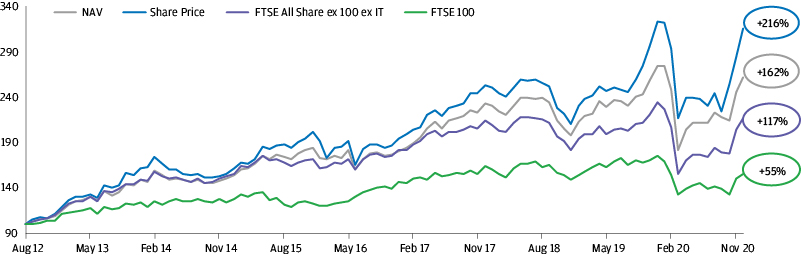
The Mercantile Investment Trust has outperformed the FTSE 100 and the UK mid- and small-cap market over the long term
Cumulative returns – August 2012 to December 2020
Source: J.P. Morgan Asset Management. GBP, as at 31 December 2020. Geometric excess returns. Performance data has been calculated on NAV to NAV basis (cum income, debt at PAR value), including ongoing charges and any applicable fees, with any income reinvested, in GBP. Please note Benchmark Indices do not include fees or operating expenses and are not available for actual investment. Past performance is not a reliable indicator for current and future results.
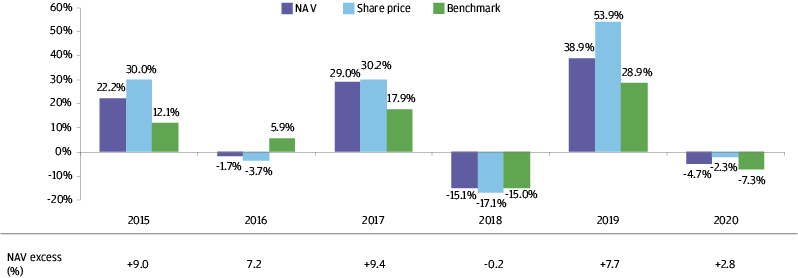
We have achieved these results with our highly experienced team and our active, disciplined investment process. For the last 25 years, the 130-year-old Mercantile Investment Trust has focused on mid- and small-cap stocks. Our specialist team of six investment professionals has an average of 14 years industry experience and conducts over 350 meetings with company managements per year.
Absolute and excess returns (net) versus FTSE All Share ex. 100 ex. Its index
Source: J.P. Morgan Asset Management. GBP, as at 31 December 2020. Geometric excess returns. Performance data has been calculated on NAV to NAV basis (cum income, debt at PAR value), including ongoing charges and any applicable fees, with any income reinvested, in GBP. Please note Benchmark Indices do not include fees or operating expenses and are not available for actual investment. Past performance is not a reliable indicator for current and future results.
The team takes an active approach to investing, with a focus on quality, leading to differentiated positioning versus the benchmark. Companies only make it into the portfolio after they meet the key criteria of our long-tested process:
- Is it a good business? We consider the company’s profitability, sustainability of earnings and capital allocation discipline.
- Is it attractively valued? We look for companies where the market appears to be underestimating future prospects.
- Is the outlook improving? We assess the operational momentum of the business and how this is being reflected in expectations.
Equally important is the process for exiting a position: if an investment is not meeting our operating expectations or if there is a sudden structural change that invalidates our thesis, we will sell the stock and recycle the capital into a better idea.
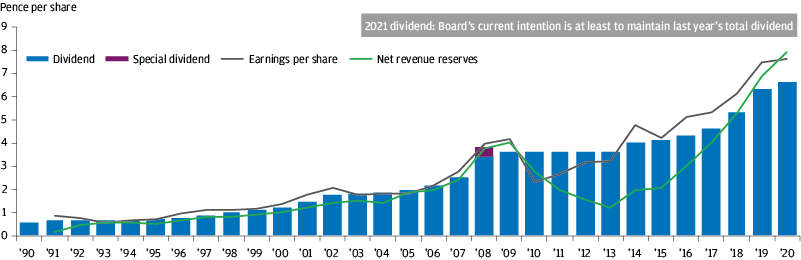
The Mercantile Investment Trust has provided steady income to investors
Source: J.P. Morgan Asset Management. GBP, as at 31 December 2020. Geometric excess returns. Performance data has been calculated on NAV to NAV basis (cum income, debt at PAR value), including ongoing charges and any applicable fees, with any income reinvested, in GBP. Please note Benchmark Indices do not include fees or operating expenses and are not available for actual investment. Past performance is not a reliable indicator for current and future results.
Mercantile’s focus on quality businesses with long-term growth potential helps generates above-average income for shareholders; its investment trust structure allows dividends to be supplemented from the trust’s reserves to maintain income, even when companies are cutting their payouts. Mercantile’s Board has stated its intention to at least maintain last year’s total dividend in the 2021 financial year.
As a closed end fund, the investment trust is also not affected by fund flows and can better weather volatility—portfolio managers do not have to sell the most liquid holdings to raise money for redemptions during times of market stress. This is a valuable benefit when investing in less liquid mid- and small-cap markets.